Thermal Interface Materials (TIMs) Heat Dissipation in Scaling AI Infrastructure
- David Rogers
- AI Buildout Supply Chain
- 2026-08-14
NEED TO KNOW
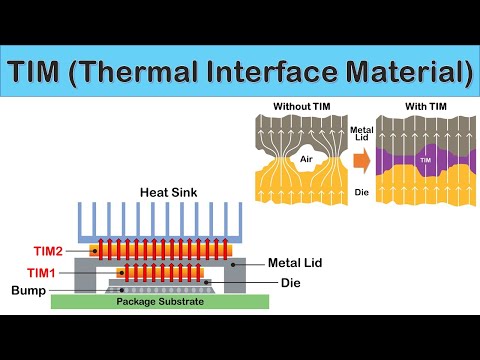
- Critical Thermal Function: Thermal interface materials (TIMs) fill microscopic surface voids between high-power dies, spreaders, and cold plates to eliminate air gaps, preventing thermal throttling in high-power (>1 kW) GPUs, ASICs, and HBM stacks.
- Core Material Families: Modern packaging relies on polymer composites (silicone loaded with BN, alumina, or CNTs for 10 W/m·K conductivity), vertically aligned graphene sheets and pads (offering ultra-high thermal conductivity without pump-out or dry-out), and metallic/liquid-metal alloys (Ga-In-Sn and indium solders offering 50–80+ W/m·K).
- Multi-Technology Roadmaps: Next-generation high-density packages—such as those presented by AMD—are moving to hybrid thermal strategies where multiple technologies (vertically aligned graphene, PCMs, and liquid-metal composites) operate concurrently across TIM1, TIM1.5 lidless, and TIM2 interfaces to conquer localized hotspots and package warpage.
- Reliability Bottlenecks: AI workloads present key mechanical failure modes, including liquid-metal pump-out, galvanic corrosion on aluminum, filler-induced viscosity limits in polymers, and die contact loss from 2.5D/3D package warpage.
- Process Innovations: Emerging solutions center on liquid-metal embedded elastomers (LMEE), vertically aligned carbon nanotubes/graphene networks, vacuum-assisted reflow to eliminate solder voids, and direct-to-die lidless TIM1.5 architectures.
- Market Growth Drivers: Driven by direct-to-chip liquid cooling and rising rack densities, the specialized AI TIM market is expanding rapidly from ~$2.5 billion in 2025 toward $5.6 billion by 2034.
- Supply Chain Risks: Primary inputs face severe geographic concentration, with China controlling ~98–99% of primary low-purity gallium production alongside significant indium refining, making synthetic nanocarbons, recycling, and supply diversification strategic priorities.
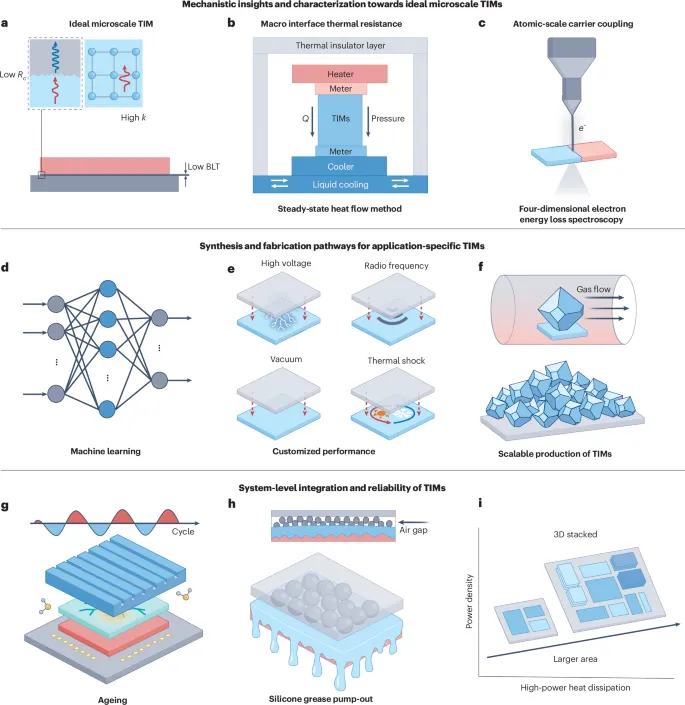
Thermal interface materials (TIMs) form the necessary bridge that transfers heat from AI processors, high-bandwidth memory (HBM) stacks, and high-power packages to heat spreaders, lids, or cold plates. Without high-performance TIMs, the high power densities of modern GPUs and ASICs which exceed hundreds of watts per chip and approach 1 kW, would cause thermal throttling or system failure /Nature Electronics/.
High-performance TIMs span three primary material paradigms. Polymer-based greases, gels, pads, and phase-change materials use pure silicone or other base polymers mixed with high amounts of thermally conductive fillers, such as boron nitride, alumina, silver flake, graphite, or carbon nanotubes. Manufacturing requires precise control of particle sizes, surface treatment of inert fillers to prevent clumping, and low ionic contamination levels to protect semiconductor packages from failure. Metal and liquid-metal TIMs (gallium-indium-tin alloys or indium solders) require high-purity gallium and indium. These materials provide bond-line thicknesses below 50 µm, thermal conductivities from ~10 W/m·K for advanced polymers to 50–80+ W/m·K for metals, and good conformability to warped packages through thousands of thermal cycles /IEEE/.
Alongside polymers and liquid metals, graphene-based TIMs are emerging as an essential material pillar due to graphene’s extraordinary intrinsic thermal conductivity. Because pure graphene conducts heat primarily along its two-dimensional plane, commercial implementations employ vertically aligned graphene (VAG) arrays, composite pads, and graphene foils to deliver high through-plane (cross-plane) heat transfer. Graphene TIMs offer a dry, chemically stable interface that eliminates the pump-out, phase separation, and dry-out failure modes common to pastes, while avoiding the galvanic corrosion and electrical short risks associated with uncontained liquid metals.
As highlighted by thermal architects at AMD and throughout the semiconductor industry, no single thermal interface technology solves every thermal boundary condition in next-generation multi-die packages. Instead, future architectures will deploy a multi-technology thermal strategy where distinct materials work together. Graphene TIMs are being positioned to sit directly between the package die and the integrated heat spreader (IHS) or cold plate (TIM1 / TIM1.5 lidless), as well as between the lid and system cold plates (TIM2), efficiently moving extreme localized heat fluxes away from GPUs, CPUs, and chiplet clusters.
Key reliability challenges under heavy AI workloads include liquid-metal pump-out, galvanic corrosion (especially with aluminum), and metal migration. Polymer systems face limits on filler loading, which increases viscosity and makes processing difficult, along with interface phonon scattering and long-term material degradation or void formation /European Polymer Journal/. Package warpage in 2.5D/3D packages and HBM stacks further reduces surface contact. Emerging production methods aim to reduce cost, waste, and processing time. These include polymer-encapsulated liquid-metal composites for better flexibility and containment, vertically aligned carbon-nanotube or graphene networks, surface-treated boron nitride for better mixing, vacuum-assisted or pressure-controlled reflow to reduce solder voids, and automated precision dispensing for high-volume assembly. These methods also enable lidless TIM1.5 designs that remove intermediate thermal interfaces.
Demand continues to grow in AI data-center GPUs and accelerators (the largest market segment), HBM packaging, server circuit boards, and liquid-cooled cold plates. Industry estimates valued the specialized AI TIM market at roughly $2.5 billion in 2025 and project it to reach $5.6 billion by 2034 /Fortune Business Insights/, with faster growth in the HBM-TIM segment. The average TIM value per AI server rack has increased significantly as premium materials replace standard greases. Higher thermal design power, denser packaging, and the adoption of direct-to-chip and immersion cooling drive this transition.
Rapid AI market growth is reshaping the TIM supply chain and accelerating commercial partnerships. Major incumbents include Henkel (BERGQUIST/LOCTITE product lines), Shin-Etsu (silicone greases), Dow, Indium Corporation (metal and liquid-metal products), Fujipoly, Parker Hannifin/Chomerics, and Honeywell. In parallel, specialized innovators are commercializing nanocarbon and graphene TIMs: Smart High Tech (SHT) has partnered with Henkel / Loctite to scale its patented graphene-enhanced GT-TIM® solutions across AI data center and semiconductor markets /Smart High Tech/; INCAVO is developing vertically aligned graphene TIMs (GA and GS series) targeting semiconductor TIM1 and TIM2 applications as well as test sockets /INCAVO/; and firms like Inspiraz Technology are demonstrating graphene-enhanced thermal interface pads and foils (such as the GBT series) for high-power electronics at major trade events like SEMICON Taiwan /Inspiraz Technology/. Concurrently, companies like Arieca specialize in liquid-metal embedded elastomers. Because primary raw materials—specifically Chinese gallium and indium refining, along with Japanese high-purity inputs—face supply concentration risks, synthetic alternatives like engineered graphene and localized recycling initiatives serve as strategic priorities to secure high-performance AI computing infrastructure.
Key Insights
What volume of TIM is required per server rack for next-generation platforms like NVIDIA’s Vera Rubin NVL72 or AMD’s Helios, and how does this change the bill of materials (BOM)?
Rack-scale architectures like NVIDIA’s Vera Rubin NVL72 (housing 72 Rubin GPUs and 36 Vera CPUs) and AMD’s Helios (housing 72 Instinct MI450-series GPUs) push rack power envelopes well beyond 100 kW. At these extreme heat fluxes, conventional thermal greases applied at milligram scales are structurally insufficient. A single NVL72 or Helios rack consumes approximately 1.5 to 2.5 kilograms of high-performance TIMs—spanning metallic phase-change materials (PCMs), vertically aligned graphene sheets, or liquid-metal composites for TIM1/TIM1.5 die-to-cold-plate interfaces, alongside ultra-high-density gap fillers for power delivery modules, network switches, and HBM4 stacks. While traditional thermal grease accounts for under $20 in a standard enterprise server, the transition to high-conductivity, highly compliant metallic, graphene, and polymer-matrix TIMs escalates the thermal BOM to $1,500–$3,500 per AI rack, transforming thermal interface materials into a high-value core component of rack-scale liquid-cooling infrastructure.
What is the most critical bottleneck process technology in scaling next-generation TIM production for high-density AI accelerators?
The paramount manufacturing bottleneck is achieving sub-50 µm bond-line thickness (BLT) with zero voiding (<1%) over large-area, severely warped 2.5D/3D semiconductor dies without inducing mechanical pump-out or material degradation under cyclic thermal stress. For polymer-matrix TIMs, increasing thermally conductive filler loading (such as surface-functionalized boron nitride or graphene) to exceed 10 W/m·K causes exponential viscosity spikes, making standard automated dispensing non-viable and raising mechanical pressure requirements during package assembly. For solder and liquid-metal alternatives, the bottleneck centers on precise vacuum-assisted reflow processing and micro-encapsulation containment (e.g., liquid-metal embedded elastomers) to prevent liquid-phase migration, galvanic corrosion on aluminum cold plates, and short circuits across ultra-dense micro-bump arrays during thousands of dynamic thermal cycles.
What are the unit economics, margin defensibility, and supply contract dynamics for specialized AI TIM manufacturers?
Specialized TIM suppliers command premium gross margins ranging from 55% to over 70%—significantly higher than commodity silicone packaging—because their products require complex synthetic chemistry, high-purity inorganic refinement (such as 6N gallium and indium), vertically aligned nanocarbon synthesis, and custom formulation IP. Due to strict qualification cycles where a TIM failure can trigger the thermal throttling or physical destruction of a $40,000+ AI accelerator die, hyperscalers and tier-1 chipmakers lock in 3-to-5-year long-term supply agreements (LTSAs) that ensure strict pricing power and high customer stickiness. Although the broader semiconductor capital cycle exhibits inherent cyclicality, TIM revenues remain highly defensible and structurally growth-oriented because thermal design power (TDP) per chip escalates across every successive architectural node, driving continuous ASP expansion as systems migrate from standard greases to custom phase-change, graphene, and liquid-metal composite formulations.