Neon, Krypton & Xenon: The Invisible Specialty Gases Powering AI Chip Manufacturing
- David Rogers
- AI Buildout Supply Chain
- 2026-07-17
NEED TO KNOW
- Invisible DUV Lithography Backbone: Semiconductor-grade neon (~96% of gas mix) and krypton enable ArF (193nm) and KrF (248nm) excimer lasers for multi-patterning lithography.
- ASU Byproduct Inelasticity: Noble gases are low-ppm byproducts of large steel-mill Cryogenic Air Separation Units (ASUs), making supply inelastic to sudden fab expansions and price volatility.
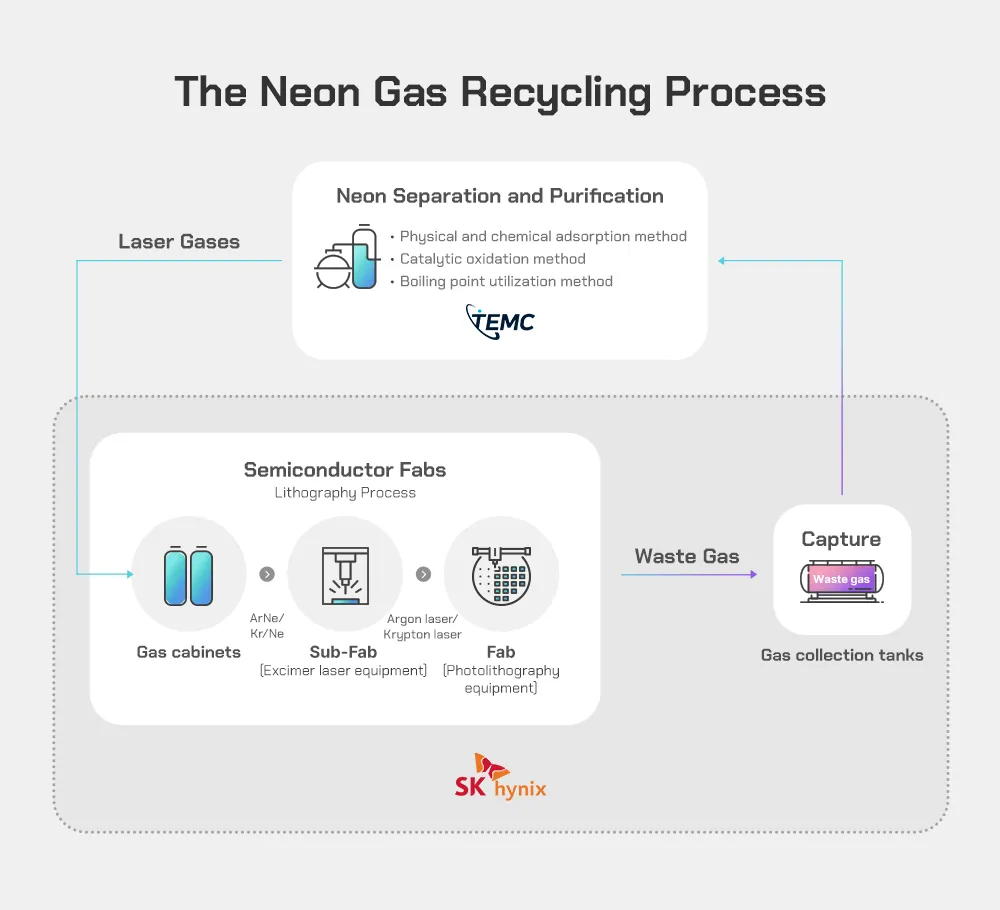
- Strategic Recycling Investments: Gas recycling and closed-loop recapture systems inside fabs can reduce fresh noble gas consumption by 70–90%.
- Long-Term Supply Contracts: Industrial gas leaders (Linde, Air Liquide, Air Products) cover 65–72% of trade via 3–5+ year contracts to buffer supply shocks.
Ultra-pure specialty gases—neon, krypton, and xenon—provide the essential foundation for semiconductor laser lithography. These noble gases power the excimer lasers inside deep-ultraviolet (DUV) lithography machines. Neon makes up approximately 96% of the gas mixture in 193 nm ArF lasers, while krypton powers 248 nm KrF lasers /ASML/. Without these high-purity laser gases, semiconductor foundries could not print the dense circuits required for AI processors, GPUs, and high-bandwidth memory chips.
Extraction begins in massive cryogenic air separation units (ASUs) tied to steel production or dedicated plants, where air is liquefied and distilled in energy-intensive stages /Linde/. Neon requires processing enormous volumes (~65,000 parts air per part neon); krypton and xenon are even rarer and demand additional enrichment columns. Semiconductor-grade output must reach 5N–6N purity (99.999%+), with oxygen, moisture, nitrogen, and hydrocarbons limited to low parts per billion levels. Any contamination destabilizes the plasma discharge, shortens gas lifetime, risks safety issues, or destroys wafer yields. Specialized blending facilities then create precise excimer mixtures under strict quality control.
The 2022 Ukraine conflict brutally exposed concentration risks: two Ukrainian firms (Ingas and Cryoin) had supplied roughly half the world’s semiconductor-grade neon (and significant shares of krypton/xenon), much of it from Soviet-era steel-mill ASUs /ASN/. Production halts triggered price spikes of 5–10× and forced fabs to burn through 3–6 month stockpiles. The shock accelerated global diversification, with new purification capacity coming online in the US /Air Liquide/, Europe, South Korea /Air Liquide/, and especially China /Yingde/, while chipmakers and gas suppliers invested in resilience.
Demand is climbing steadily, propelled by AI accelerators, high-bandwidth memory (HBM), advanced packaging, and legacy/specialty node expansion. Although EUV lithography (13.5 nm) has taken over the thinnest layers at sub-5 nm nodes, DUV immersion (ArFi) remains workhorse technology for multi-patterning steps and critical layers in advanced logic, memory, and mature nodes /ASML/. Overall noble gas demand for electronics is projected to grow at 6–9% CAGR through the late 2020s, with neon demand exceeding 600–700 million liters annually.
Specialty Noble Gas Extraction & Laser Blending Process
Cryogenic Air Separation
Air LiquefactionCompress and cool atmospheric air in large industrial columns until it turns into cryogenic liquid.
Crude Side-Stream Fractionation
Rare Gas SeparationDistill crude gas side-streams containing trace neon, krypton, and xenon from liquid oxygen.
Catalytic Oxidation & Purging
Impurity CleanupPass crude noble gas mixtures through chemical reactors to burn off hydrocarbons, hydrogen, and moisture.
Multi-Stage Distillation & Blending
Laser Gas ProductionDistill noble gases to 99.9999% purity and mix them into precise gas blends for chipmaking DUV excimer lasers.
Key challenges revolve around supply concentration, geopolitical volatility, and the energy intensity of cryogenic separation. Past shocks triggered severe price spikes and supply anxieties /Reuters/. Emerging solutions focus on three pillars: closed-loop on-site gas recycling systems (which capture, purify, and reuse >90% of excimer gas, reducing fresh demand by up to 90%), geographic diversification of ASUs (new capacity in the US, Europe, Japan, China, and Korea), and advanced membrane/adsorption technologies /Air Products/ that cut the energy required for secondary purification. These innovations improve supply security while lowering environmental and operating costs.
Supply chain structure is an oligopoly dominated by global industrial gas majors—Linde, Air Liquide, Air Products, and Nippon Sanso—who control the majority of purification, logistics, and long-term supply contracts with major fabs (TSMC, Samsung, Intel, SK Hynix). Strategic stockpiles (typically 1–3 months of supply at fabs), expanded recycling, and localized purification facilities have significantly reduced vulnerability compared to 2022. As AI hardware drives higher wafer volumes, rare noble gases remain a fundamental, though now better-protected, pillar of the global semiconductor ecosystem.
Key Insights
What are the typical annual volumes of neon, krypton, and xenon consumed in a large semiconductor fabrication plant, and how does planned new fab construction over the next three years proxy future demand for these excimer laser gases?
A large advanced semiconductor fab running 50–100 excimer lasers typically consumes 15,000–20,000 cubic meters of semiconductor-grade neon annually on a gross basis for ArF (~95–96% of the mixture) and KrF DUV lithography, with significantly lower volumes of krypton for KrF and specialized etch processes and only trace xenon in certain stabilized mixtures or niche applications; on-site recycling systems recovering 85–92% or more of the exhaust gas now reduce net fresh consumption to a small fraction of gross usage. Global 300mm fab equipment spending is projected to total $374 billion from 2026 to 2028, with advanced process capacity (7nm and below) growing 69% to reach 1.4 million wafers per month by 2028 amid AI-driven logic and HBM expansion—implying dozens of new or expanded fabs coming online over the next three years as a clear proxy for rising specialty gas demand, even after recycling efficiencies and supplier diversification.
What is the most critical bottleneck in the process technology or supply chain for specialty excimer laser gases like neon, krypton, and xenon in advanced AI chip production?
The primary bottleneck is achieving and consistently maintaining ultra-high purity (5N–6N, with ppb-level control of O₂, H₂O, N₂, and hydrocarbons) during cryogenic air separation, multi-stage purification, precise blending with halogens like fluorine, and closed-loop recycling, all while scaling to meet AI-driven lithography demand. These gases are produced as low-volume byproducts of large ASUs tied to steel output, creating inherent supply inelasticity; new capacity requires 12–18 months lead time and lengthy customer qualification (often 6–12+ months). Recycling systems help but are not universally deployed at leading-edge nodes, and any impurity spike directly risks laser instability, yield loss, or safety issues in high-repetition-rate ArF/KrF tools essential for 3nm-class Rubin GPUs. Geopolitical and energy-linked concentration risks compound the technical constraints even as diversification accelerates.
What are the unit economics of neon, krypton, and xenon specialty gases for semiconductor manufacturing, including long-term supply agreements, cyclicality, and margin growth or defensibility?
These ultra-pure excimer laser gases command high unit value due to extreme purity requirements and scarcity, with suppliers securing long-term agreements (typically 3–5+ years, often bundled with argon, helium, or on-site ASU contracts spanning 15–20 years) that now cover 65–72% of trade and provide revenue stability for producers like Linde, Air Liquide, and Air Products. The business is highly cyclical, tracking semiconductor capex and wafer starts—surging with AI fab builds but contracting sharply in downturns (as seen in 2022–2023 inventory corrections), though long-term contracts and recycling have narrowed price volatility from historical ±25% swings to around ±6%. Margins are structurally attractive and defensible in the electronic-grade segment (often 20–40% operating levels for specialty merchant gases) thanks to high barriers: proprietary purification/blending IP, rigorous fab qualification, on-site recycling technology, and integration with customer facilities, enabling margin expansion as AI demand tightens supply and rewards localized, high-reliability providers.
How have light source manufacturers and the semiconductor industry responded to neon gas shortages affecting excimer laser supply for advanced chip production?
Light source manufacturers such as Cymer and leading chipmakers have countered neon shortages—driven by Ukraine supply shocks that once risked 15%+ cuts and 20× price spikes—through rapid short-term containment solutions and optimized gas-refresh algorithms that reduced consumption by ~30% immediately and up to 50% overall while preserving laser performance, combined with long-term recycling programs that reclaim over 95% of neon from spent ArF/KrF excimer gas via on-site filtration, reconstitution, or supplier return loops. These measures, supported by strategic 1–2 month stockpiles, accelerated qualification of alternative global suppliers, and deeper scientific insight into neon’s essential role in stabilizing (ArF)* plasma for efficient 193 nm DUV lithography, avoided fab shutdowns and delivered industry-wide savings of more than 70 million liters of neon per year (valued at over $200 million), enabling sustained production of advanced nodes critical for AI accelerators even as modern recycling systems now routinely achieve 85–92% recovery.