The Physics of Flight and the Economics of Scale: Drone Manufacturing Technology and Last-Mile Delivery
- David Rogers
- 2026-09-14
NEED TO KNOW
- The Last-Mile Economic Bottleneck: Traditional courier vans burn 1.5–2.0+ kWh/mile and cost $2.50 to $5.50 per residential drop, with labor driving 65% of OPEX to deliver parcels that weigh under 5 lbs in 85%+ of e-commerce orders.
- Aerodynamic Hybrid Architecture: The Amazon Prime Air MK30 transitions from vertical multi-rotor takeoff to wing-borne aerodynamic cruise at 67–73 mph, slashing motor power draw by over 60% compared to pure multicopters over a 7.5-mile operational radius.
- Aeroacoustic Engineering: Custom-engineered toroidal and swept carbon composite propellers alter blade-passage frequency pressure waves, reducing perceived acoustic volume by 50% to meet FAA Part 135 and NEPA residential soundscape thresholds.
- The Composite Manufacturing Dilemma: Aerospace carbon-fiber prepreg autoclave curing ($150–$300/kg, 4–8 hr cycles) is too slow for commercial fleet scale, while injection-molded thermoplastics lack the structural modulus required for high-aspect-ratio UAV wings.
- CBAM High-Rate Additive Production: Composite-Based Additive Manufacturing (Impossible Objects / Ricoh 3D) uses high-speed inkjet binding on continuous long-fiber carbon sheets with PEEK/PA12 matrix powders, achieving >150 MPa tensile strength at 10x the speed of legacy additive systems.
- BVLOS 1:N Fleet Autonomy: Beyond Visual Line of Sight regulatory approval paired with onboard stereo-vision sense-and-avoid ML and AWS One Amazon Lane cloud UTM shifts operator ratios from 1:1 to 1:N supervisory control, targeting sub-$1.25 delivery unit economics.
For decades, the final three miles of the logistics supply chain have represented a structural paradox. Over 85% of parcels shipped across global e-commerce networks weigh less than five pounds (2.26 kg)—a bottle of medication, a smartphone charging cable, a tube of sunscreen, or a pack of dental floss. Yet to transport this sub-five-pound cargo, fulfillment networks dispatch a four-ton, internal-combustion or battery-electric step van navigating congested suburban street grids. This mechanical mismatch is financially and energetically ruinous: last-mile delivery routinely accounts for 50% to 53% of total parcel shipping costs, burning between 1.5 and 2.0+ kWh per mile and incurring direct operational costs between $2.50 and $5.50 per residential doorstep delivery. The primary cost driver is not the electrons or diesel fuel, but human driver labor, which comprises roughly 65% of last-mile operating expenses while capping delivery speed at the throughput of urban road traffic.
Autonomous aerial delivery completely rewrites this energetic and economic balance sheet. By transitioning last-mile transportation from constrained two-dimensional road topology to the open three-dimensional lower sky (under 400 feet above ground level), electric unmanned aerial vehicles (UAVs) bypass road congestion entirely, cutting transit times from hours to under 15 minutes. An electric package delivery drone consumes roughly 0.12 to 0.18 kWh per mile—less than one-tenth the energy of an electric delivery van and comparable to a light electric cargo bicycle. However, scaling commercial drone delivery from boutique demonstration flights into an industrial utility capable of moving 500 million packages annually by 2030 requires solving two interdependent engineering frontiers: the airframe composite manufacturing bottleneck and the autonomous unit economics of Beyond Visual Line of Sight (BVLOS) operations.
The Aerodynamic & Acoustic Architecture of the MK30
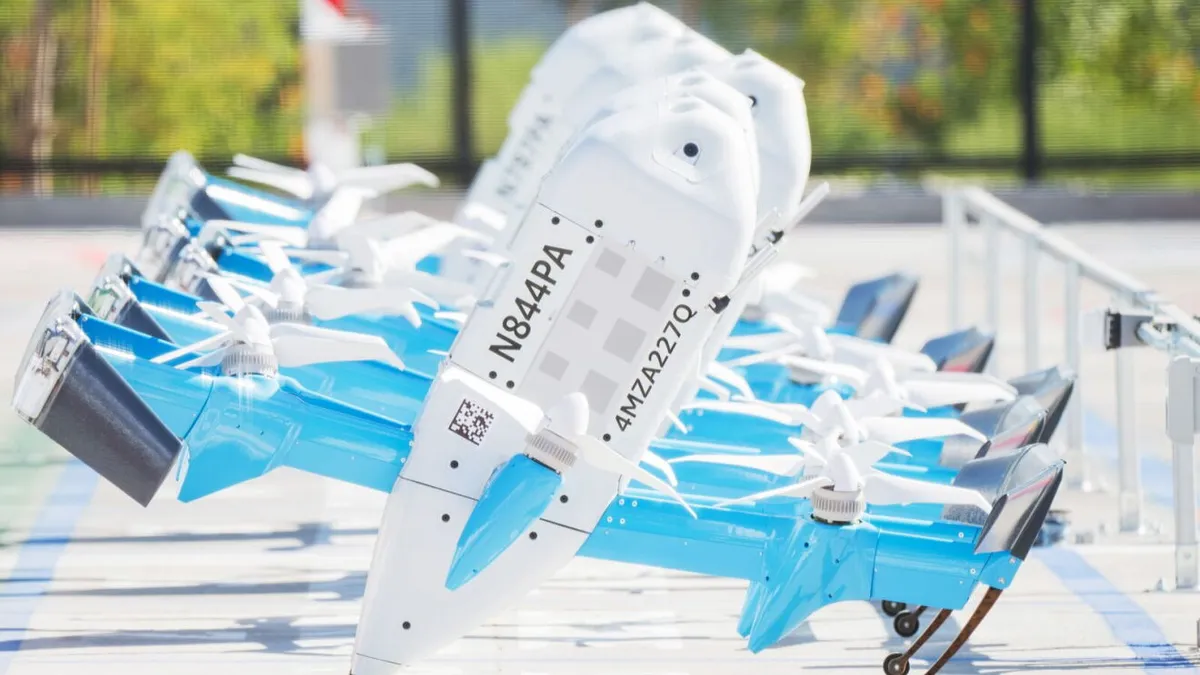
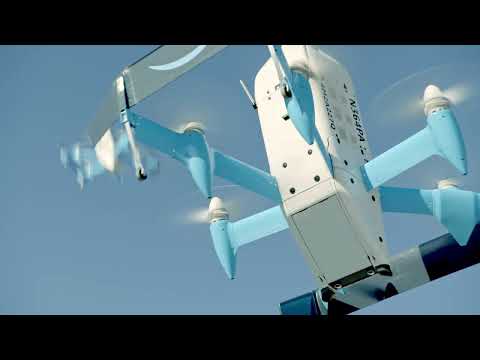
The physical realization of this transition is embodied in Amazon’s latest Prime Air delivery platform, the MK30 /Amazon Prime Air/ /Amazon News/. Deployed commercially across the Phoenix West Valley metro area in Arizona and College Station, Texas, the MK30 is a purpose-built hybrid vertical takeoff and landing (VTOL) tail-sitter aircraft. Unlike pure multi-rotor drones (which must continuously expend high electrical power to maintain rotor disk loading in hover throughout their mission), the MK30 takes off vertically on six brushless electric propulsors, rotates its pitch axis, and transitions into horizontal, wing-borne forward flight.
| Flight Phase | Altitude (AGL) | Velocity & Mode | Aerodynamic State | Motor Power Draw | Operational Function |
|---|---|---|---|---|---|
| Vertical Launch | 0 to 180 ft | 0–15 mph (Vertical climb) | Multi-rotor pure hover thrust | 100% (Peak load) | Safely clears fulfillment center launchpad infrastructure |
| Transition Phase | 180 ft | 15 $\rightarrow$ 67 mph | Pitch rotation to wing-borne lift | 70%–85% | Offloads vertical lift from propulsors to fixed wings |
| Outbound Cruise | 180 to 377 ft | 67–73 mph (64 knots) | Steady-state aerodynamic wing lift | 35%–40% | High-efficiency transit over 7.5-mile delivery radius |
| Delivery Descent | 12 to 15 ft | Low hover descent | Multi-rotor active DAA descent | 60%–75% | Autonomous drop from internal fuselage cargo bay |
| Inbound Return | 180 to 377 ft | 67–73 mph (64 knots) | Empty-payload aerodynamic cruise | 30%–35% | Return to PADDC automated charging and turnaround pad |
Once in aerodynamic cruise, lift is generated by the wing chord according to classical aerodynamics (L = 0.5 · ρ · v² · S · C_L, where ρ is air density, v is cruise velocity of 67 to 73 mph / 64 knots, S is wing surface area, and C_L is the lift coefficient). By offloading vertical support to aerodynamic wing surfaces, motor electrical current draw drops by over 60% compared to hover mode. This aerodynamic efficiency allows the 78-pound empty airframe (83.2-pound maximum takeoff weight / MTOW) to carry a 5.0-pound payload over a 7.5-mile operational radius (a 15-mile round-trip range) while retaining strict energy reserves for FAA-mandated diverted landings and turbulent headwind compensation.
The central engineering challenge of suburban drone delivery, however, is not aerodynamic lift—it is psychoacoustics. Under the FAA’s National Environmental Policy Act (NEPA) review process /FAA/, community noise exposure is the primary barrier to high-density commercial flight authorizations. Multi-rotor propellers generate piercing tonal noise at their blade-passage frequency [BPF = (RPM × Blade Count) / 60] and high-frequency broadband turbulence from tip vortex shedding. To overcome this, Prime Air engineers developed custom toroidal, swept carbon-composite propellers that break up tip vortex structures and redistribute acoustic energy across a wider frequency band. The result is a 50% reduction in perceived acoustic volume compared to earlier drone generations, allowing the aircraft to cruise at 180 to 377 feet AGL and blend seamlessly into suburban ambient soundscapes (~45–50 dBA) before descending to drop packages from an enclosed fuselage bay.
The Composite Manufacturing Trilemma: Why Autoclaves Cannot Scale
While aerodynamic architectures have matured, UAV hardware scaling is constrained by an aerospace manufacturing trilemma. An autonomous delivery drone is subject to severe structural requirements: it must survive thousands of dynamic vertical-to-horizontal flight transitions, withstand severe gust loads, resist torsional flutter on high-aspect wings, shed moisture in light precipitation, and provide structural crashworthiness—all while keeping airframe tare weight below 80 pounds.
Historically, composite fabrication has been trapped between two incompatible paradigms:
- Aerospace Hand-Layup & Autoclave Prepreg: Continuous carbon fiber fabrics impregnated with thermoset epoxy are manually or semi-automatically cut, laid into expensive metal molds, bagged, and cured inside pressurized autoclaves at 120°C–180°C and 6–7 bar pressure. While this yields optimal specific strength and minimal void content (<1%), cycle times are glacial (4 to 8 hours per cure cycle), scrap rates can reach 20–30%, and finished part costs range from $150 to $300 per kilogram. This makes autoclave curing economically non-viable for fleets numbering in the tens of thousands.
- Thermoplastic Injection Molding / Chopped Extrusion: High-speed injection molding can produce parts in 30-second cycle times at low cost, but short, discontinuous fibers provide poor tensile strength (<80 MPa) and low flexural modulus (<5 GPa). High-aspect aerodynamic drone wings molded from unreinforced or short-fiber polymers flex under gust loads, causing control surface binding, aeroelastic flutter, and rapid fatigue failure /Composites Part B: Engineering / ScienceDirect/.
Composite-Based Additive Manufacturing (CBAM)
To bridge this chasm between structural performance and high-rate mass production, advanced manufacturing consortia such as America Makes /America Makes/ have pioneered Composite-Based Additive Manufacturing (CBAM), developed by Impossible Objects /Impossible Objects/ and commercialized in partnership with industrial print giant Ricoh 3D /Ricoh 3D/ /TCT Magazine/ /VoxelMatters/.
Unlike selective laser sintering (SLS) or fused deposition modeling (FDM) that slowly trace toolpaths line-by-line, CBAM operates on continuous sheet lamination principles at full gantry speeds:
- High-Speed Inkjet Wetting: Continuous non-woven long-fiber carbon, glass, or Kevlar sheets are fed through a roll-to-roll or automated sheet feeder. Thermal or piezoelectric inkjet printheads deposit proprietary aqueous binding fluids across the sheet in the exact 2D cross-sectional slice geometry dictated by the component CAD model.
- Matrix Powder Adhesion: High-performance thermoplastic polymer powders—such as Polyether Ether Ketone (PEEK), Polyamide 12 (PA12), or Polyketone—are dusted across the sheet. The dry powder adheres strictly to the fluid-wetted areas, while excess powder is vacuum-reclaimed.
- Automated Registration & Stacking: Successive patterned sheets are stacked in precise mechanical registration, building a pre-form block containing hundreds of composite layers.
- Thermal Compression Consolidation: The entire sheet stack is transferred into a heated platen press. Under controlled temperature and hydraulic pressure, the thermoplastic powder melts and flows into the continuous fiber interstitial voids, fusing the layers into a monolithic, isotropic composite billet.
- Matrix Unmasking: The consolidated block is placed into an automated abrasive bead-blasting chamber. The non-bonded, untreated fiber surrounding the component is blasted away and collected for recycling, revealing the finished, fully dense composite part with no support structure scarring.
| Manufacturing Process | Fiber Architecture | Matrix Polymer | Tensile Strength (MPa) | Flexural Modulus (GPa) | Takt Time per Part | Tooling Cost |
|---|---|---|---|---|---|---|
| Autoclave Prepreg Layup | Continuous Woven Fabric | Thermoset Epoxy | 600–1,200 | 45–70 | 4–8 hours | Very High ($50k–$250k) |
| Injection Molding | Short/Chopped Fiber (<1mm) | PA66 / PBT | 80–140 | 4–8 | 30–60 seconds | High ($30k–$150k) |
| FDM / Filament 3D Print | Chopped Carbon Fiber | PA12-CF / PETG | 50–95 | 3–6 | 8–18 hours | Zero |
| CBAM (Impossible Objects / Ricoh) | Long-Fiber Non-Woven Sheets | Carbon-PEEK / Carbon-PA12 | 150–220 | 12–18 | 3–5 minutes | Zero (Digital CAD) |
CBAM delivers up to 10x to 15x the throughput of conventional industrial 3D printers, enabling production rates of up to 10,000 drone airframe components per month per manufacturing cell, as demonstrated in defense production lines at the U.S. Army’s Rock Island Arsenal. More crucially, CBAM enables functional part consolidation: internal conduit channels for avionics wire harnesses, antenna cavities, sensor mounting hardpoints, and aerodynamic ducting can be grown directly inside monolithic wing spars and fuselage cowlings. This eliminates dozens of aluminum brackets, mechanical fasteners, and adhesive bond lines—slashing assembly labor and eliminating the dimensional tolerance stackup failure modes that plague multi-piece glued assemblies.
The Unit Economics of Scale: BVLOS and Cloud Orchestration
The transition from expensive prototype delivery flights to profitable unit economics depends fundamentally on the labor-to-aircraft ratio.
Under early FAA Part 107 test regimes, commercial drone operations were crippled by visual line of sight (VLOS) mandates. Each aircraft required a licensed remote pilot in command (PIC) and one or two visual observers (VOs) stationed along the flight corridor. In this 1:1 or 2:1 human-to-drone operating model, labor costs exceeded $10.00 to $15.00 per drop, making aerial delivery vastly more expensive than a diesel delivery van.
The economic inflection point arrives with Beyond Visual Line of Sight (BVLOS) authorization under FAA Part 135 air carrier certification. By equipping the MK30 with an onboard perception stack—combining optical stereo-vision cameras, radar, and edge machine learning processors that detect and avoid (DAA) unmapped hazards like utility wires, trees, pets, and non-cooperative aircraft—the drone operates as an autonomous agent.
This onboard autonomy enables the 1:N supervisory control model: a single remote logistics technician situated in a central operations room monitors a fleet of 10 to 20 drones concurrently, intervening only if an automated health monitor triggers an anomaly alert.
Coupled with centralized cloud orchestration through platforms like AWS One Amazon Lane /AWS Air Delivery/, the entire delivery sequence is automated:
- Automated Order Induction: At Same-Day Sub-Same-Day (SSD) distribution hubs and Prime Air Drone Delivery Centers (PADDC) co-located with fulfillment infrastructure, robotic arms induct eligible items directly into the MK30’s belly pod.
- Dynamic 4D Deconfliction: Cloud-based Unmanned Traffic Management (UTM) computes real-time, four-dimensional collision-free flight corridors, incorporating live hyper-local microclimate weather data, FAA temporary flight restrictions, and neighbor flight vectors.
- Autonomous Turnaround: Upon returning from delivery, the drone lands on automated charging pads where battery packs are either rapidly recharged or swapped mechanically, minimizing turnaround takt time to under five minutes.
At a 1:20 operator ratio and high daily asset utilization (15 to 20 deliveries per drone per day), the fully loaded cost per delivery drops dramatically:
| Cost Component | Traditional DSP Van ($ / Delivery) | Drone 1:1 VLOS Pilot ($ / Delivery) | Scaled Drone 1:20 BVLOS ($ / Delivery) |
|---|---|---|---|
| Driver / Pilot Labor | $3.15 | $12.50 | $0.42 |
| Vehicle CAPEX Amortization | $0.65 | $2.20 | $0.38 |
| Energy / Fuel Consumption | $0.45 | $0.15 | $0.06 |
| Maintenance & Battery Degradation | $0.50 | $0.85 | $0.22 |
| Insurance, Overhead & Cloud UTM | $0.30 | $0.75 | $0.17 |
| Total Cost Per Delivery | $5.05 | $16.45 | $1.25 |
The Industrial Convergence
The commercial scaling of autonomous drone delivery is not an isolated aerodynamic feat—it is the direct manifestation of modern advanced manufacturing and physical autonomy converging. Over the past two weeks, our analyses have traced the breakdown of legacy assembly lines: from Elon Musk’s “idiot index” stripping cost out of high-rate powertrains, to unboxed modular vehicle architectures replacing rigid Fordist conveyors, to dry electrode battery processing eliminating energy-intensive solvent ovens.
Package delivery drones follow this exact same industrial trajectory. By substituting heavy, multi-piece stamped sheet metal assemblies with high-rate, digital composite-based additive manufacturing (CBAM), airframes achieve aerospace structural stiffness without incurring aerospace fabrication costs. By replacing 4-ton ICE delivery vans with 80-pound wing-borne VTOL aircraft, kinetic energy consumption drops by an order of magnitude. And by replacing manual steering wheels with onboard ML sense-and-avoid vision running under cloud-orchestrated BVLOS corridors, last-mile labor chokepoints dissolve.
The companies that win the next decade of logistics will not be those that buy more delivery vans—they will be the manufacturing organizations that master high-rate composite airframe synthesis, aerodynamic transition efficiency, and automated 1:N fleet orchestration to turn the lower sky into the world’s most capital-efficient supply chain.
Subscribe to Exponential Industry
Get weekly technical deep dives on first-principles manufacturing, industrial supply chains, and advanced hardware delivered straight to your inbox.
Subscribe on SubstackKey Insights
Why are traditional delivery vans economically mismatched for last-mile e-commerce?
More than 85% of e-commerce packages weigh less than 5 pounds (2.26 kg) and occupy under 0.2 cubic feet. Dispatching a 9,000-pound step-van or electric delivery vehicle to haul a single pill bottle or phone charger creates a massive energetic and capital mismatch. Delivery vans consume 1.5–2.0+ kWh/mile, navigate congested two-dimensional street networks, and incur high driver labor costs ($2.50–$5.50 per stop), making last-mile shipping represent over 50% of total parcel logistics costs.
How does the Amazon MK30 achieve its range and noise reduction targets?
The MK30 is an 83.2-pound maximum takeoff weight (MTOW) hybrid VTOL aircraft. It lifts off vertically using six brushless propulsors, then tilts into horizontal wing-borne flight where the wing chord generates aerodynamic lift (L = 0.5 · ρ · v² · S · C_L), cutting cruise energy consumption by over 60% relative to pure hover. To overcome community noise complaints, Amazon engineered swept carbon-composite propellers that break up tip vortices and redistribute acoustic energy away from human-sensitive tonal frequencies, cutting perceived sound pressure by half.
What is Composite-Based Additive Manufacturing (CBAM) and why is it vital for UAV production?
Developed by Impossible Objects and commercialized with Ricoh 3D, CBAM uses high-speed thermal inkjet printheads to deposit aqueous binding fluid in exact CAD slice cross-sections across sheets of non-woven carbon or fiberglass. Thermoplastic matrix powders (such as PEEK or PA12) adhere to the wetted areas before the sheets are stacked, thermally consolidated under a platen press, and sandblasted to remove unbound fiber. This yields lightweight continuous-fiber composite components with tensile strengths exceeding 150 MPa at 10x–15x the throughput of SLS/FDM, enabling high-rate, low-cost drone airframe fabrication without expensive autoclave tooling.
How do BVLOS approvals and cloud orchestration impact drone delivery economics?
Under early visual line of sight rules, drone operations required dedicated ground observers and pilot ratios of 1:1 or 2:1 per aircraft, pushing per-delivery costs above $10.00. FAA Part 135 Beyond Visual Line of Sight (BVLOS) certification, enabled by onboard machine learning sense-and-avoid cameras and AWS One Amazon Lane cloud traffic management (UTM), allows a single remote operator to supervise 10 to 20 autonomous drones concurrently (1:N scaling). This slashes labor costs per flight and drives marginal delivery costs down toward $1.00–$1.50 per package.