Unboxed vs. Intelligent Islands: The Two Post-Fordist Automotive Manufacturing Paradigms
- David Rogers
- 2026-09-12
NEED TO KNOW
- The Century-Old Assembly Bottleneck: Ford’s 1913 sequential moving line confines interior assembly inside a hollow welded Body-in-White (BIW) cage, capping operator density at 2–3 technicians per station while the paint shop consumes 40–50% of plant CAPEX and over 60% of thermal energy.
- Tesla Unboxed Parallel Architecture: By decomposing the car into six modular subassemblies built and trimmed simultaneously on parallel spurs, Tesla mounts seats and interior trim directly onto an open structural battery skateboard, targeting a 50% manufacturing cost reduction and 40% smaller factory footprint.
- One-Step Framing & Tolerance Stackup: Snapping gigacastings and pre-finished body sides together in a single robotic adhesive framing cell eliminates progressive line rework, but introduces severe geometric tolerance stackup (T_total = Σ Δt_i) mirroring Boeing’s 787 composite fuselage mating crisis.
- Intelligent Island (Matrix) Production: SAIC-GM-Wuling’s I²MS and Hyundai’s HMGICS replace continuous chain conveyors with AMR/AGV-linked autonomous process cells, enabling simultaneous mixed-model assembly of up to 24 distinct vehicle platforms with 2-hour changeovers.
- Cost Optimization vs. Option Value: Tesla wagers on hyper-volume, single-model unit cost minimization for the Cybercab, whereas Chinese and European OEMs prioritize dynamic option value and capital resilience against rapid platform obsolescence.
- Physical AI & Humanoid Convergence: Open-skateboard topologies and conveyor-less robotic grids create the ideal operational environment for dual-arm physical AI models (Skild AI) handling deformable wire harnesses and humanoid workers (XPENG IRON) eliminating rigid body-shop tooling.
For over 113 years, automotive manufacturing has been held hostage by Henry Ford’s moving assembly line. The basic mechanical sequence established at Highland Park in 1913 remains standard practice across Detroit, Stuttgart, and Toyota City: stamp hundreds of steel panels, spot-weld them into a hollow steel cage known as the Body-in-White (BIW), submerge the entire multi-ton skeleton into chemical E-coat dip tanks and high-temperature curing ovens, and unbolt the painted doors so assembly workers can contort themselves into door apertures to route wire harnesses and bolt down pedals. The physics of this enclosed box creates severe operational bottlenecks. Only two or three operators can physically occupy a vehicle cabin at any 60-second takt-time station without colliding. Worse, the thermal and capital requirements of the monolithic paint shop account for 40% to 50% of a modern assembly plant’s total capital expenditure while consuming over 60% of its thermal energy. If a single cross-threaded fastener or missing harness stalls one workstation, the entire multi-kilometer conveyor chain freezes. Automotive manufacturing has reached the thermodynamic limits of the sequential moving line.
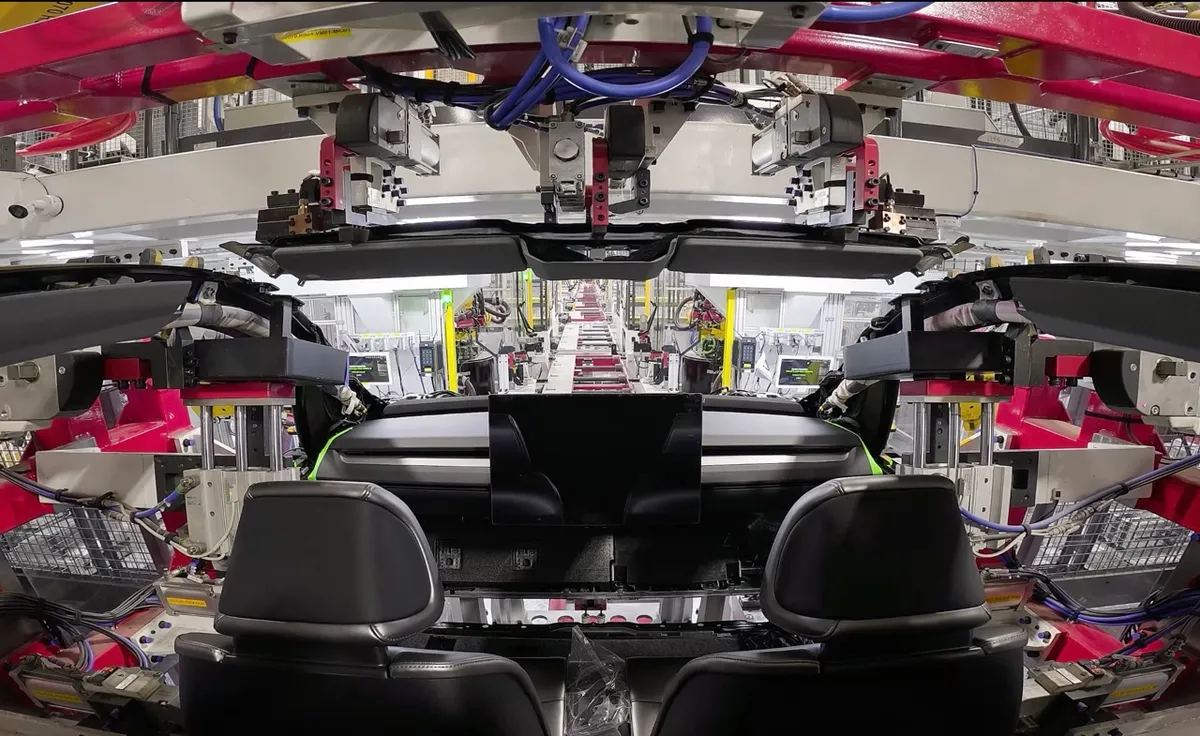
Tesla’s answer to this century-old legacy is the Unboxed Assembly Process, engineered under vehicle engineering lead Lars Moravy and deployed for the Cybercab (Robotaxi) at Gigafactory Texas. Rather than snaking a single enclosed chassis down a monolithic conveyor, Tesla decomposes the car into six modular subassemblies built simultaneously on parallel spurs: the front megacasting, rear megacasting, structural battery pack, left and right body side apertures, and the glass canopy. The breakthrough lies in interior packaging. Because the seats, center console, HVAC ducting, and carpet are bolted directly onto the open structural battery pack before any side pillars or roof panels exist, assembly technicians and robotic actuators work with 360-degree unobstructed access from a comfortable standing posture. Monolithic dip tanks and expansive curing ovens are eliminated; exterior panels are either finished in compact, high-efficiency horizontal paint cells or molded directly from high-impact in-mold color polymers using reaction injection molding (RIM). The pre-tested modules converge at a single “one-step framing” cell where high-payload robots lock global datum references, applying high-strength structural adhesives and mechanical fasteners to finalize the vehicle in one motion. Tesla targets a 50% reduction in vehicle manufacturing cost and a 40% reduction in factory spatial footprint.
Yet this modular revolution introduces severe geometric and supply-chain vulnerabilities, as analyzed by Wharton operations expert Gad Allon /Gad Allon/. Traditional stamped-sheet unibodies are forgiving: spot-weld guns bend compliant steel flanges into position, absorbing minor dimensional deviations of ±1.5 mm before paint curing. In an unboxed architecture, massive high-pressure die-cast aluminum structures must snap together with interference-fit precision like rigid Lego bricks. High-pressure gigacastings inherently experience 1.2% to 1.5% volumetric thermal shrinkage and post-quench distortion. When mating two massive gigacastings directly to a rigid structural battery floor and pre-finished aperture panels in a single framing station, geometric errors accumulate linearly. If tolerances stack too tightly, structural stress concentrations induce microcracking; if too loose, panel gaps yield aerodynamic buffeting and water intrusion. The failure mode directly parallels Boeing’s 787 Dreamliner crisis, where pre-stuffed composite fuselage barrels manufactured by international suppliers arrived out-of-round at the final Everett assembly hall, stalling production for months while technicians custom-machined micro-shims /The Wall Street Journal/ /The Seattle Times/. As vehicle teardown specialists at Caresoft Global have documented /Autoline / Caresoft Global/ /Automotive News/, unboxed assembly also enforces extreme product rigidity: while hyper-efficient for a single high-volume envelope like the two-seat Cybercab, running different wheelbases or rooflines through the same rigid one-step framing cell is virtually impossible without completely rebuilding the tooling fixtures.
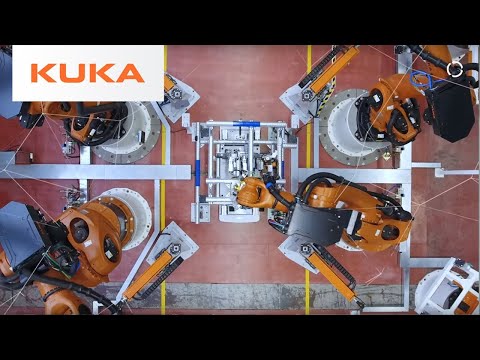
While Tesla bets on hyper-volume cost minimization for a singular vehicle geometry, Chinese and European automakers are scaling an entirely different post-Fordist architecture: conveyor-less Intelligent Island Manufacturing (or Matrix Production). At SAIC-GM-Wuling’s (SGMW) flagship smart factory in Liuzhou, recognized by China’s Ministry of Industry and Information Technology (MIIT) as a National Flagship Smart Factory /Qiushi/, the continuous conveyor belt has been torn out completely. Production is partitioned into self-contained process islands interconnected by fleets of omnidirectional Autonomous Mobile Robots (AMRs) and Automated Guided Vehicles (AGVs). Controlled by a centralized dynamic dispatch system, each vehicle chassis travels along an individualized path, docking only at the islands required for its specific bill of materials. If an all-wheel-drive variant requires additional powertrain calibration or a luxury trim requires a panoramic glass roof, the vehicle detours into a dedicated cell while standard variants bypass the station entirely. This eliminates the takt-time starvation that cripples linear moving lines. SGMW’s I²MS architecture supports the simultaneous mixed-model assembly of 24 distinct vehicle platforms across varying wheelbases and body styles on a single floor, slashing model changeover times from two days to just two hours, reducing equipment CAPEX by 40%, and elevating overall equipment effectiveness by 20%. Hyundai Motor Group has implemented a matching conveyor-less smart cell paradigm at its HMGICS facility in Singapore /Hyundai Motor Group/, using real-time digital twins to assemble the Ioniq 5, Ioniq 6, and Level 4 robotaxis concurrently across 50 modular cells.
The battle for post-Fordist manufacturing reveals a profound divergence in industrial philosophy. Tesla is optimizing for monolithic unit economics: by locking the physical envelope of the Cybercab, eliminating the paint shop, and assembling parallel submodules, it aims to drive total manufacturing costs below $20,000 per vehicle. But this efficiency sacrifice eliminates portfolio optionality and amplifies vulnerability to geometric tolerance stackup. Conversely, Chinese and European intelligent island networks are optimizing for option value: in an electric vehicle market characterized by brutal price competition and rapid architectural obsolescence, the ability to pivot an entire plant between 24 vehicle form factors in two hours protects capital against volatile consumer demand. Both paradigms, however, converge on the same technological catalyst: physical AI and next-generation robotics. Open structural battery skateboards potential enable AI foundation models, such as Skild AI’s S1, to master the complex dual-arm manipulation required for flexible wire harnesses and blind-mate coolant connectors without human intervention. Simultaneously, humanoid robots like XPENG’s IRON and Boston Dynamics’ electric Atlas are moving into conveyor-less manufacturing islands to handle dynamic material transfer and precision mechanical fastening. Whether through monolithic unboxed cells or distributed robotic islands, the century-old moving assembly line is being challenged.
Subscribe to Exponential Industry
Get weekly technical deep dives on first-principles manufacturing, industrial supply chains, and advanced hardware delivered straight to your inbox.
Subscribe on SubstackKey Insights
Why are automakers challenging Henry Ford's traditional moving assembly line?
Ford’s 1913 linear assembly line forces every vehicle through an identical sequential chain. Once sheet metal parts are welded into a hollow Body-in-White (BIW) shell, physical access is choked by door and windshield openings, limiting worker density to 2–3 operators per 60-second takt station. Furthermore, running the entire steel shell through multi-stage E-coat dip tanks and high-temperature curing ovens consumes 40–50% of a plant’s capital expenditure and 60% of its thermal energy. Finally, any single tool failure or cross-threaded fastener immediately stalls the entire multi-kilometer line.
How does Tesla's Unboxed Assembly process work, and what are its advantages?
Tesla's Unboxed Process divides the vehicle into six discrete subassemblies—front megacasting, rear megacasting, structural battery pack, left body aperture, right body aperture, and roof canopy—that are fabricated and trimmed simultaneously on dedicated parallel spurs. Technicians and robots install seats, carpets, HVAC ducting, and center consoles directly onto the flat, open structural battery floor with unobstructed 360-degree access before body sides are attached. The pre-tested modules meet at a final "one-step framing" cell where robots bond and fasten them together, eliminating traditional dip-tank paint shops, reducing plant footprint by 40%, and cutting manufacturing costs by up to 50%.
What are the primary engineering risks and limitations of the Unboxed model?
The central vulnerability of the unboxed method is dimensional tolerance stackup. Unlike pliable spot-welded steel sheet metal that absorbs millimeter variations across dozens of weld seams, monolithic high-pressure aluminum gigacastings undergo 1.2–1.5% thermal contraction and post-cooling warpage. When mating rigid castings with pre-trimmed side panels in a single framing station, small millimeter discrepancies compound linearly. Tight clearances cause structural stress risers, while loose gaps yield panel fitment defects and water leaks—recapitulating Boeing's multi-month assembly shutdown on the 787 Dreamliner fuselage barrels. Additionally, the rigid framing jigs make running multiple body styles on the same unboxed line virtually impossible.
What is Intelligent Island manufacturing, and how does it contrast with Tesla's strategy?
Intelligent Island Manufacturing (or Matrix Production), pioneered by SAIC-GM-Wuling (I²MS) and Hyundai (HMGICS), completely eliminates continuous conveyor belts in favor of decoupled, autonomous process cells interconnected by fleets of Autonomous Mobile Robots (AMRs). Central dispatch software dynamically routes each chassis only to the specific islands required for its custom configuration, decoupling cycle times and bypassing unnecessary stations. While Tesla trades platform flexibility for rock-bottom unit costs on a single uniform geometry, Intelligent Island plants achieve extreme agility—building up to 24 distinct vehicle models on the same floor with 2-hour tooling changeovers and 40% lower equipment CAPEX.