Dry Electrode Manufacturing: Eliminating Solvents, Ovens, and the Gigafactory Footprint
- David Rogers
- 2026-09-09
NEED TO KNOW
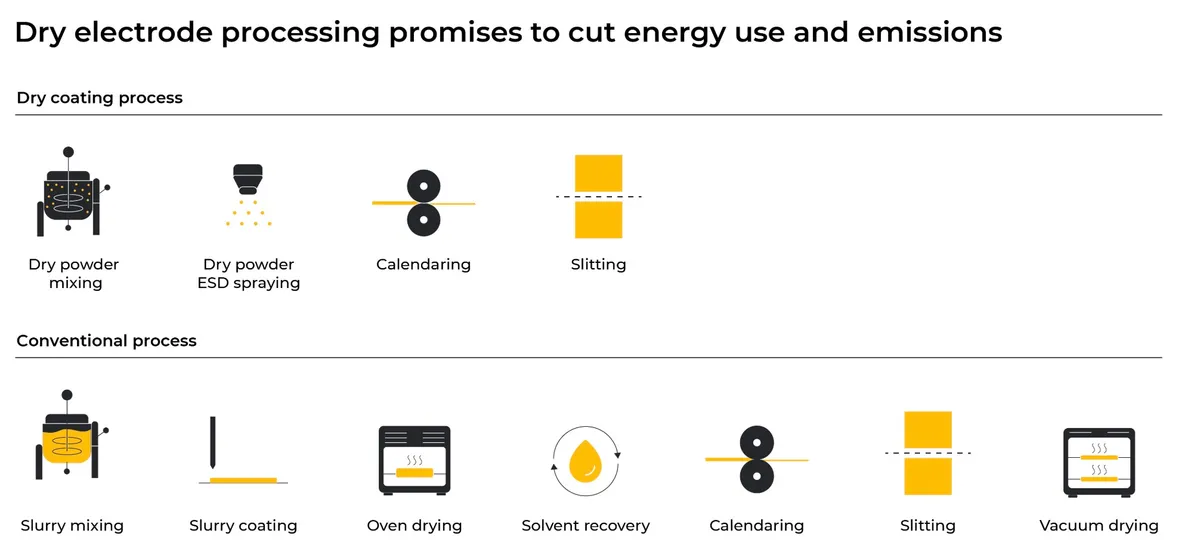
- Solvent and Oven Elimination: Replacing wet-slurry casting with dry electrode processing eliminates toxic N-methyl-2-pyrrolidone (NMP) solvents and 50- to 100-meter drying ovens, compressing electrode line footprint by up to 70%.
- Gigafactory Energy Reduction: Traditional convection drying lines consume 30 to 50 kWh of energy per kWh of finished cell capacity; dry processing slashes coating energy demand by up to 40% while removing expensive solvent condensation loops.
- Microstructural Uniformity: Eliminating solvent evaporation prevents capillary binder migration to the electrode surface, removing the primary cause of coating delamination, uneven impedance, and localized thermal hotspots.
- Active Material Density Gains: Fibrillated PTFE binders require only 1% to 2% weight content compared to 3% to 5% PVDF in wet slurries, elevating active cathode loading to 97–98% and boosting volumetric energy density.
- Single-Crystal Cathode Imperative: High-pressure calender rolls can fracture conventional polycrystalline NMC agglomerates into loose primary particles; switching to single-crystal cathode active materials prevents micro-cleavage and capacity fade.
- Enabler for Solid-State Batteries: Because sulfide and halide solid electrolytes chemically degrade in polar liquid solvents, solvent-free dry deposition serves as the vital manufacturing bridge for solid-state cells operating up to 150°C.
Traditional lithium-ion battery manufacturing is tethered to a century-old papermaking legacy: the wet-slurry casting line. Across tier-one gigafactories operated by manufacturers like CATL /CATL/ /Volta Foundation/, cathode production requires mixing active powders, conductive carbon, and polyvinylidene fluoride (PVDF) binders inside giant tanks filled with N-methyl-2-pyrrolidone (NMP)—a costly, toxic, and regulated organic solvent. The resulting wet sludge is pumped through slot-die coaters onto thin current-collector foils before entering massive 50- to 100-meter-long convection drying ovens. These ovens operate as massive industrial thermal sinks, typically consuming 30 to 50 kilowatt-hours of electrical energy for every single kilowatt-hour of finished cell capacity /Rigaku/. Beyond their immense energy appetite and capital expenditure, ovens dictate factory architecture, accounting for over 40% of an electrode plant’s physical footprint alongside complex multi-million-dollar solvent condensation and distillation towers. Dry battery electrode (DBE) processing eliminates solvent chemistry entirely, cutting cleanroom footprint by up to 70% and fundamentally restructuring the unit economics of cell production.
The 5-Stage Dry Battery Electrode Manufacturing Flow
Pneumatic Powder Blending
Low-Shear Active MixingCathode or anode active powders (such as single-crystal NMC or synthetic graphite) are blended with conductive carbon additives and 1–2% PTFE binder powder in low-shear pneumatic or acoustic mixers to ensure homogeneous dispersion without fracturing delicate active particles.
PTFE Shear Fibrillation
Polymer Web FormationThe dry blend is passed through a high-shear mechanical processor or initial heated roller stage where frictional shear stress forces spherical PTFE particles to unwind into a continuous microscopic network of interlocking fibrils.
Multi-Pass Roll Calendering
Free-Standing Film FormationSuccessive pairs of precision heated calender rolls apply 500 to 1,500 kN/m of linear pressure to progressively compress and elongate the fibrillated mass into a dense, uniform, free-standing electrode film between 50 and 200 microns thick.
Direct Hot Lamination
Current Collector BondingThe free-standing dry electrode sheet is fed alongside primed aluminum or copper foil through heated lamination rolls, bonding the active layer firmly to the current collector without the use of liquid solvent-based adhesives.
Continuous Slitting & Winding
Solvent-Free Cell AssemblyLaminated electrode coils are laser-slit to precision dimensions and routed directly to automated tabless winding or z-folding stations for cylindrical (4680) or prismatic cell assembly, bypassing hours of baking and solvent recovery.
The physics of wet drying also imposes severe electrochemical penalties that dry processing directly resolves. As hot air evaporates NMP from wet coatings, capillary action pulls low-density binder molecules and nanoscale carbon black toward the outer surface of the electrode. This phenomenon, known as binder migration, starves the foil-electrode interface of binder while concentrating an insulating film at the separator interface. The result is mechanical fragility, high interfacial contact resistance, localized thermal hotspots, and poor fast-charging kinetics under high C-rates. By moving to dry processing, active materials arrive as free-flowing powders and are mixed directly with a fibrillatable binder—predominantly polytetrafluoroethylene (PTFE) at fractions as low as 1% to 2% by weight, compared to 3% to 5% PVDF in wet recipes. Reducing binder dead weight allows active material loading to reach 97% to 98%, directly boosting volumetric energy density while eliminating the capillary forces that induce binder segregation. Microstructural studies indicate that electrodes manufactured with dry fibril networks retain roughly 90% of their original capacity after 2,000 deep discharge cycles /Tesla/.

However, dry processing introduces a demanding mechanical challenge: forming a cohesive, flexible, and micro-crack-free film under pure roll pressure without tearing or wrinkling. When subjected to heated shear between precision calender rolls, spherical PTFE particles unwind into an interconnected, spiderweb-like matrix of microscopic fibrils that entrap cathode active material and conductive carbon particles. Recent research in the Journal of Energy Storage emphasizes that the success of this roll-forming process depends heavily on the morphology of the active material /Journal of Energy Storage/. Conventional nickel-rich cathode active materials (such as NMC811 or NMC955) consist of secondary agglomerates composed of thousands of primary nanocrystals. Under the extreme linear calender pressures (often exceeding 1,000 kN/m) required to achieve uniform dry film density, these polycrystalline spheres can fracture along internal grain boundaries, leading to particle pulverization, electrolyte side-reactions, and rapid capacity fading. Consequently, dry cathode manufacturing is catalyzing an industry-wide transition toward single-crystal cathode active materials (SC-NMC), whose monolithic crystalline structures withstand immense calendering forces without micro-cleavage. Furthermore, integrating porous carbon frameworks with hollow internal channels provides low-tortuosity micropathways that ensure rapid lithium-ion transport even through densely compacted dry coatings.
The commercial race to bring dry electrode equipment into high-rate automotive production is intensifying across North America and Asia. Tesla, which acquired pioneering dry-process IP from Maxwell Technologies in 2019, has reached continuous manufacturing scale for 4680 dry cathode cells at its Gigafactory Texas cathode plant /Basenor/. By commissioning its first in-house large-scale calcination and calender lines, Tesla eliminated solvent recovery infrastructure and shortened 4680 cell manufacturing cycle times, aligning with its target to reduce cell capital costs by over $1,000 per vehicle pack. Simultaneously, alternative dry coating architectures are bypassing free-standing calender webs entirely. Boston-based AM Batteries has commercialized an electrostatic spray deposition (ESD) Powder to Electrode™ platform, recognized by TIME as one of the best manufacturing inventions /TIME/ /AM Batteries/. Instead of extruding a fragile free-standing sheet, the electrostatic method charges dry powder mixtures and deposits them uniformly onto current-collector foils under an electric field, immediately followed by heated roll compaction. Backed by strategic investments from Porsche and Toyota Ventures, AM Batteries joined a $50 million U.S. Department of Energy consortium led by Coreshell Technologies to scale 2 GWh of domestic dry cathode lines, appointing former Maxwell CEO Dr. Franz Fink to lead roll-to-roll commercialization /PR Newswire/.

Beyond slashing cost and carbon emissions for liquid-electrolyte lithium-ion cells, dry processing represents the essential manufacturing gateway for solid-state batteries. Sulfide-based solid electrolytes—the frontrunner chemistry for solid-state commercialization—react violently or decompose when exposed to polar organic solvents like NMP or moisture, making traditional wet-slurry casting virtually impossible without severe degradation. This critical synergy was demonstrated by Panasonic Energy’s breakthrough announcement of a solid-state battery capable of operating at temperatures up to 150°C in a compact prismatic form factor /Reuters/. Developed under Panasonic’s “Takumi” technical engineering development initiative /Panasonic Energy/, the high-temperature cell uses solvent-free dry powder compaction to form intimate, void-free interfaces between the solid electrolyte and active electrodes. These pristine solid-solid interfaces eliminate thermal decomposition channels, expanding potential applications into demanding automotive sensors, under-hood electronics, and medical sterilization equipment. As gigafactories transition from early pilot lines to multi-gigawatt facilities /EI/, dry electrode processing is shifting from an optional cost-optimization strategy into the mandatory manufacturing foundation for next-generation energy storage.
Subscribe to Exponential Industry
Get weekly technical deep dives on first-principles manufacturing, industrial supply chains, and advanced hardware delivered straight to your inbox.
Subscribe on SubstackKey Insights
What is the core difference between wet slurry casting and dry electrode manufacturing?
In traditional wet processing, active cathode materials, conductive carbon, and PVDF binders are suspended in a toxic organic solvent (NMP) to form a wet slurry, which is coated onto metal foils and transported through massive 50- to 100-meter drying ovens to evaporate the liquid. In contrast, dry battery electrode (DBE) processing eliminates solvents entirely: powdered active materials and binders are blended dry, mechanically fibrillated into a free-standing cohesive film or electrostatically sprayed directly onto current collector foils, and laminated under heated pressure rolls.
Why does the conventional wet drying process cause cell degradation and performance limits?
During the drying phase in conventional ovens, the rapid upward capillary flow of evaporating NMP solvent drags lightweight binder and conductive carbon nanoparticles toward the outer surface of the electrode. This "binder migration" leaves the foil interface binder-deficient, causing adhesion loss, mechanical peeling, uneven electrical resistance, and accelerated capacity fade under high-rate DC fast charging.
How does PTFE fibrillation work in dry electrode fabrication?
Polytetrafluoroethylene (PTFE) possesses unique viscoelastic properties that cause its spherical polymer particles to unwind into a dense microscopic mesh of spiderweb-like fibrils when subjected to controlled mechanical shear and moderate heat (80–150°C). This fibril network physically entangles active cathode or anode particles and conductive carbon into a flexible, free-standing sheet without requiring chemical adhesives or solvent evaporation.
Why is dry electrode manufacturing essential for next-generation solid-state batteries?
Most leading solid-state battery chemistries rely on sulfide- or halide-based solid electrolyte powders that react violently or chemically degrade when exposed to the polar organic solvents (such as NMP) or water used in wet slurries. Solvent-free dry electrode processing enables uniform compaction and roll lamination of intact solid electrolyte and active material interfaces without chemical contamination, unlocking safe operation across wide thermal windows up to 150°C.