How Autonomous Labs Turn Failed Experiments Into Discovery Engine Inventory
- David Rogers
- 2026-09-08
NEED TO KNOW
- Negative Results as Structured Inventory: Closed-loop laboratories treat failed conditions as training data rather than losses, using Bayesian optimization and active learning to systematically eliminate unviable search spaces.
- Hardware Abstraction Standards: Emerging open standards (such as Anthropic’s Model Hardware Standard) connect heterogeneous instruments—liquid handlers, robotic arms, and lasers—in hours rather than months.
- Unified Automation Data Loops: Platforms like Benchling Automation centralize data streams across hundreds of instrument classes, enabling AI agents to analyze results and dispatch subsequent microplates without human intervention.
- Measurable Biotechnology Cost Drops: Pairing frontier models with automated cloud labs has demonstrated up to 40% reductions in protein synthesis costs, 57% lower reagent consumption, and 50–90% savings in modular DNA synthesis via fragment reuse.
- Materials Discovery Characterization Hurdles: While autonomous facilities (such as Berkeley's A-Lab and Dunia's GigaLab) can synthesize dozens of inorganic targets in days, automated crystallographic verification (PXRD) remains a primary technical bottleneck.
- Institutional Rigor as the Limiting Factor: Discovery throughput is no longer constrained by physical assay execution speed, but by data provenance, phase verification, and automated biosafety and chemical guardrails.
Edison did not treat ten thousand dead ends as failures. He treated them as useful inventory. The popular quote—“I have not failed. I’ve just found 10,000 ways that won’t work”—is a later summary of remarks he and his team made during long test campaigns. They tested light-bulb filaments, ore separators, and batteries for years, using up massive amounts of raw material before finding a workable design. Menlo Park operated like a factory for negative results: technicians tested carbonized bamboo, hair, fishing line, and thousands of plant fibers. Each negative test showed the team what not to build. The modern autonomous laboratory applies this exact logic, but with much lower operational costs. Robotic workcells and machine learning models now test this inventory of failed conditions overnight. Human scientists can then spend their working hours on the small set of hypotheses that justify expensive physical experiments.
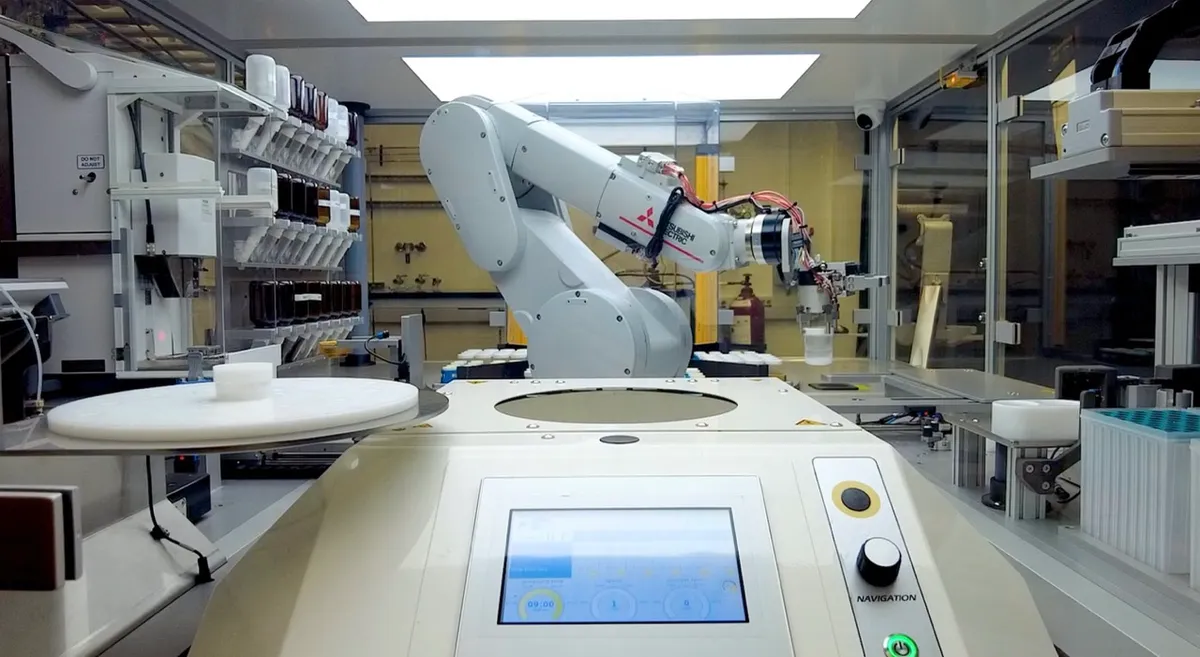
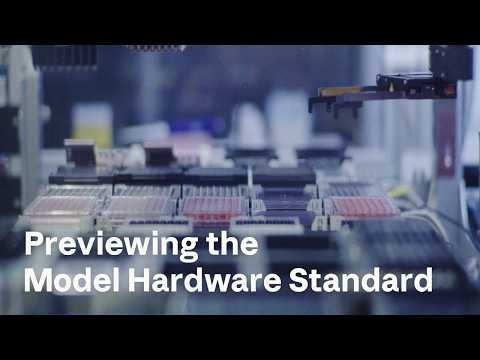
Building this workflow no longer requires custom hardware from a single vendor. Anthropic’s Model Hardware Standard research preview creates a common interface that reduces instrument setup time from months to hours /Anthropic/. Autonomous software agents can now run liquid-handling robots, mechanical arms, optical microscopes, and laser systems simultaneously. Early users report running chemical dose-response tests three times faster, as well as automatically restoring optical laser locks without human intervention. Benchling Automation, launched in May 2026 with partners such as Ginkgo, HighRes, Automata, and Hamilton, provides the matching software layer for laboratory data. The platform collects test results from more than 200 instrument types into a central electronic notebook, sends execution orders to the next microplate, and keeps the digital models, biological samples, and experimental records synchronized. Teams are also applying this automated closed-loop method to solid materials discovery, as seen in Dunia’s planned €280 million Berlin GigaLab, while companies like Siemens, Accenture, and BASF deploy similar systems to convert factory quality-control labs to continuous 24-hour operation.
This tight feedback loop already shows measurable cost and performance improvements in biotechnology. OpenAI reported that a GPT-5 model, connected to Ginkgo’s automated cloud laboratory, evaluated more than 36,000 cell-free protein synthesis mixtures across 580 multi-well plates. The system lowered total protein production costs by 40 percent and reduced reagent consumption by 57 percent, partly by finding chemical mixtures that flow reliably through automated pipettes /OpenAI/. In another application, AstraZeneca used its FRAGLER pipeline inside Benchling to track and reuse modular DNA parts across iterative design cycles /Benchling/. This approach cut gene synthesis and sequencing costs by 50 to 90 percent, because later experimental rounds could assemble existing fragments rather than ordering new ones. Specialized life-science models—such as GPT-Rosalind and AWS BioDiscovery design tools—rely directly on this automated infrastructure: algorithms can propose far more molecular variants because synthesizing a plasmid or testing a protein no longer consumes weeks of manual labor.
Materials discovery follows a similar economic pattern, though confirming the physical properties of a new solid is harder than sequencing DNA. Self-driving chemistry and materials laboratories are now established engineering systems running 24/7 autonomous experimentation loops /Scientific American/. They link active-learning algorithms, robotic synthesis tools, and automated literature extraction to ensure that computational models generate structures that chemists can actually synthesize in a reactor. The A-Lab project at Lawrence Berkeley National Laboratory demonstrated both the speed and the verification challenges of this method: the system synthesized 36 out of 57 target inorganic materials during 17 days of continuous operation, though researchers later published technical corrections after other laboratories re-analyzed the crystalline phase purity of the samples /LBL/. For small-molecule discovery, platforms like ClickGen use modular, high-yield reaction rules, grounded in Nobel-winning click and bioorthogonal chemistry, to take computational designs to validated biological test data within weeks /Nobel Prize/. Computation does not remove the need for physical tests. Instead, each dollar spent on instrument time and raw chemical precursors produces higher-value data for the next round, driving down discovery costs across large parameter spaces.
Edison’s ten thousand trials depended entirely on manual human labor. Autonomous laboratories fundamentally improve the economics of that search: hardware setup takes less time, robotic systems run assays unattended overnight, optimization loops reduce chemical consumption, and software catalogs previous biological parts and powder recipes for reuse. The main engineering constraint is no longer whether a laboratory can execute ten thousand physical tests. The real challenge is whether an organization can verify its analytical data, enforce biosafety controls, and document conclusions as systematically as the robots that execute the work. The genuine return on investment comes from reducing physical waste, eliminating instrument downtime, and ensuring that every new experiment builds directly on the thousands of tests that came before it.
Key Insights
What is a closed-loop autonomous laboratory, and how does it differ from traditional lab automation?
Traditional lab automation uses robots to run repetitive, pre-programmed protocols at fixed scale. A closed-loop autonomous laboratory (or self-driving lab) integrates robotics, analytical instrumentation, and AI or Bayesian optimization algorithms into a continuous feedback loop: the system executes experiments, analyzes characterization data in real time, updates its predictive models, and autonomously designs the next round of physical assays without requiring manual human intervention between cycles.
How do self-driving labs turn "failed" experiments into useful inventory?
In conventional research, unpromising or negative experimental results are often discarded or undocumented. Closed-loop platforms log every condition, parameter, and negative outcome as structured training data. Active-learning models leverage these negative results to map boundary conditions and map unviable regions of the chemical or biological search space, preventing wasteful re-testing and directing physical experiments toward high-probability candidates.
What are the main technical bottlenecks facing autonomous laboratories today?
While liquid handling, reaction scheduling, and robotic movement are largely solved engineering problems, the primary bottlenecks lie in characterization, phase purity verification, and cross-vendor instrument integration. In materials science, verifying crystal structures via powder X-ray diffraction (PXRD) often requires nuanced human interpretation. Additionally, integrating heterogeneous hardware and enforcing stringent data provenance, biosafety guardrails, and automated quality controls remain the defining operational challenges.
What economic impact have automated cloud labs achieved in biotechnology and materials discovery?
Automated cloud laboratories have demonstrated substantial cost reductions: pairing frontier models with robotic biology suites has cut cell-free protein synthesis costs by up to 40% and reduced reagent usage by 57%. In modular DNA synthesis, pipelines reusing standardized genetic fragments have lowered sequencing and synthesis costs by 50% to 90%. Furthermore, 24/7 continuous operation maximizes capital utilization of expensive lab instruments, accelerating discovery timelines from months to days.