The Idiot Index: How Elon Musk Uses First-Principles Engineering to Cut Costs from Raptor to Cybercab
- David Rogers
- 2026-09-07
NEED TO KNOW
- The "Idiot Index" Metric: Measures manufacturing waste by calculating the ratio between the total cost of a finished part and the spot-market price of its raw materials.
- SpaceX Raptor Application: Redesigning parts for high-rate factory production dropped Raptor manufacturing costs from roughly $2 million to a target near $200,000, enabling Starship's 33-engine booster architecture.
- The 5-Step Algorithm: Formalized across SpaceX and Tesla to eliminate waste in strict sequence: challenge requirements, delete parts/steps, simplify and optimize, accelerate cycle time, and finally automate.
- Cybercab Rare-Earth Elimination: The Cybercab drive unit eliminates expensive, geopolitically concentrated rare-earth magnets by using a high-density hairpin stator topology without sacrificing range.
- Automated Takt Times: Designed for automated assembly lines with sub-10-second cycle times, the Cybercab powertrain is 18% smaller and 25% lighter than comparable high-performance EV units.
- Target Fleet Economics: High vehicle efficiency (around 165 Wh/mi) and a low bill of materials support target fleet operating costs near $0.20 per mile, directly undercutting donor-car robotaxi models on cost per occupied mile.
Elon Musk uses a metric called the “idiot index.” It measures the ratio between the finished cost of a part and the cost of the raw materials inside it. A high ratio usually means the design is too complex or the factory process creates too much waste: “If the ratio is high, you’re an idiot.” Walter Isaacson’s biography /Amazon/ shows Musk applying this rule to SpaceX’s Raptor engine. Early units of this methane-oxygen engine looked like a tangled bush of tubes and cost roughly $2 million each. Because the raw metals cost only a small fraction of that total, Musk set a target price near $200,000. He took personal control of propulsion engineering and directed teams to fix parts with the worst ratios—such as a steel nozzle jacket quoted at $13,000 when the raw steel cost only $200.
The Algorithm: Elon Musk's 5-Step Engineering & Manufacturing Process
Challenge the Requirements
Make Requirements Less DumbQuestion every constraint and specification, regardless of who authored it. As requirements are inherently flawed, engineers must interrogate assumptions and eliminate dumb rules before designing around them.
Delete a Part or Process Step
Value Chain EliminationExamine the complete value chain to remove unnecessary process steps and delete parts. Eliminating components reduces labor, shortens cycle times, cuts failure modes, and yields immediate system-level optimization.
Simplify and Optimize the Design
Ease of ManufacturabilityOnly after removing nonessential parts and steps should engineers simplify the remaining design. Optimize components to streamline factory fabrication and squeeze out additional points of operational performance.
Accelerate Cycle Time
Increase Manufacturing CadenceFind every way to go faster across the production floor. Add parallel stations and ramp up throughput to compress takt time, but only after simplifying and deleting steps to avoid speeding up waste.
Automate (and Repeat)
Lock In the Baseline ProcessAutomate strictly as the final step once the baseline process is lean. Avoid automating steps that should have been deleted; once automated, continuously repeat the cycle to uncover further opportunities for reduction.
The goal was not to negotiate with suppliers. The team had to delete parts, eliminate extra machining steps, and design components for high-rate factory production instead of traditional aerospace methods. Raptor 2 cost roughly half as much to build as Raptor 1. Later versions eliminated more 3D-printed parts and mechanical fasteners. This made the engine cheap enough to install 33 units on a single Super Heavy booster while keeping the Starship program economically viable. That same first-principles engineering framework, treating rocket engines like mass-manufactured hardware, is what commentator x1Ler described this week: “He’s doing the same thing to everything.”
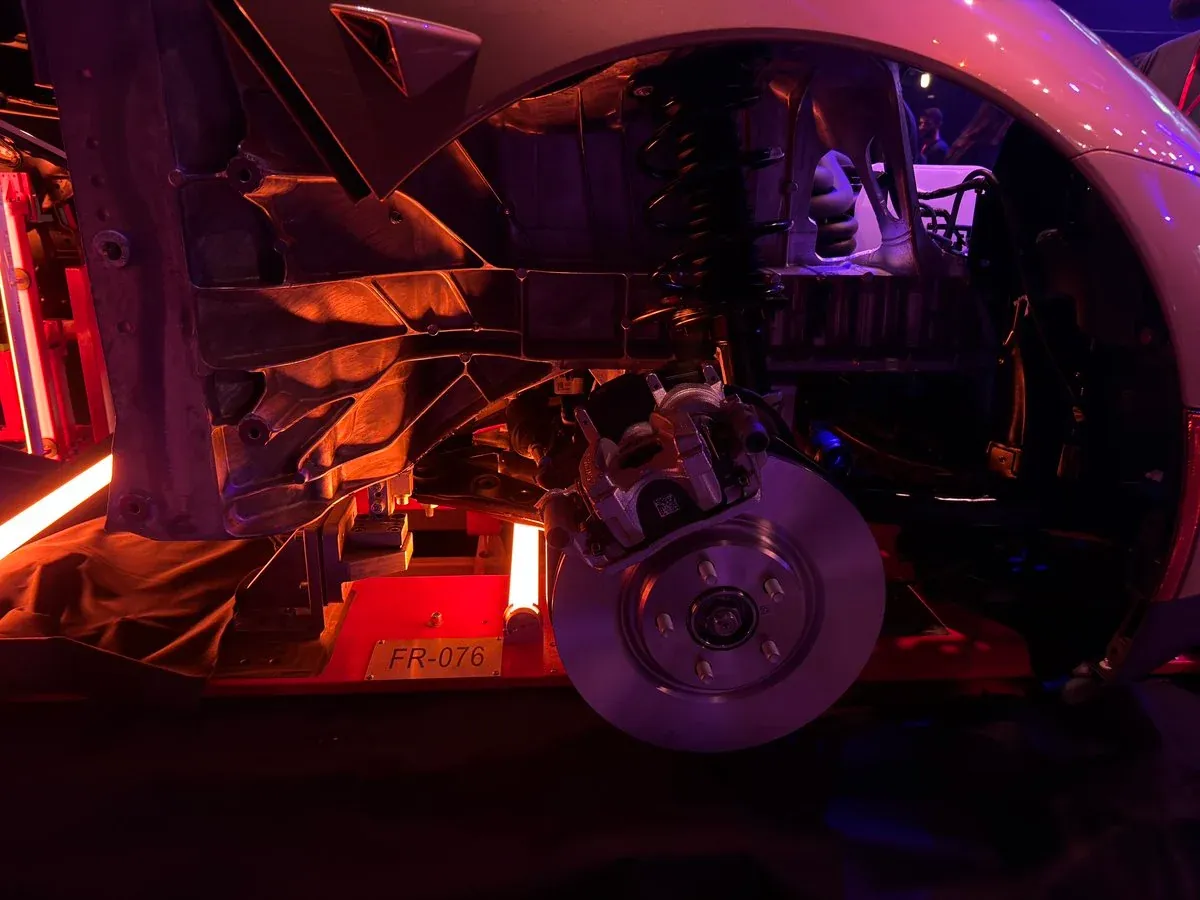
That approach now shapes the Tesla Cybercab drive unit. Investor Sawyer Merritt reported that the unit uses a simplified bar-wound (hairpin) stator and an upgraded lubrication system /X/. Designed for fully automated assembly lines with cycle times under 10 seconds, the drive unit is 18% smaller, 25% lighter, and more efficient than existing high-performance electric vehicle motors. Musk made a more demanding claim: the motor operates without rare-earth metals while maintaining full driving range, an engineering task he called “extremely hard to achieve” /X/. This directly applies the idiot index to motor design. Rare-earth permanent magnets carry high raw material costs and concentrated supply chain risks. By removing them, packing more copper wire into the stator slots, shrinking the overall housing, and automating assembly, Tesla reduces both material and labor costs at the same time.
Performance and cost scale together. A lighter, more efficient 163 kW drive unit cuts overall vehicle mass and lowers electrical demand in a two-seat vehicle rated at roughly 165 Wh/mi—making it one of the most efficient production electric vehicles built. At standard utility electric rates, charging costs drop to roughly two to three cents per mile. Tesla targets vehicle manufacturing costs between $20,000 and $30,000, with fleet operating expenses near $0.20 per mile. Goldman Sachs analysts project that lower material costs and capital expenditures give Tesla a $0.05 to $0.30 per-mile cost advantage over robotaxis built on modified $50,000 to $100,000 passenger cars. Initial public ride fares in Austin already undercut Tesla Model Y robotaxi runs and standard Uber trips, showing how factory cost reductions transfer directly into lower consumer prices.
The competitive impact extends beyond an improved motor. The Cybercab is an integrated, purpose-built vehicle where the drivetrain, brake-by-wire controls, and factory cycle times function as a unified cost system: fewer rare materials, fewer failure points, less vehicle weight to move, and an automated line that builds drive units in seconds. If Tesla sustains these manufacturing rates during mass production, the Cybercab will not compete against premium electric cars on horsepower. It will compete directly against Uber and Waymo on the total cost per occupied mile—the primary metric that decides profitability for autonomous fleets /EI/.
Subscribe to Exponential Industry
Get weekly technical deep dives on first-principles manufacturing, industrial supply chains, and advanced hardware delivered straight to your inbox.
Subscribe on SubstackKey Insights
What is the "idiot index," and how does Elon Musk apply it?
The idiot index is a first-principles metric that calculates the ratio between the total finished manufacturing cost of a part and the spot-market cost of its raw materials. A high ratio indicates that the manufacturing process is riddled with excess complexity, wasteful machining, or unnecessary steps. Musk uses it to identify parts with the greatest cost-reduction potential and redesign them for high-rate mass manufacturing.
How did the idiot index reduce SpaceX Raptor engine costs?
Early SpaceX Raptor engines cost roughly $2 million each because they were built using low-volume aerospace methods with complex tubing, numerous fasteners, and machined assemblies. By targeting parts with high idiot index ratios—such as a $13,000 nozzle jacket made from $200 of raw steel—engineers simplified designs and eliminated parts, halving costs with Raptor 2 and targeting ~$200,000 per engine.
What is "The Algorithm" and why must the steps be completed in order?
"The Algorithm" is a five-step production methodology: (1) Challenge requirements, (2) Delete parts or process steps, (3) Simplify or optimize the design, (4) Accelerate cycle time, and (5) Automate. Following the steps in strict sequence prevents engineers from making the common mistake of automating or speeding up processes that should never have existed in the first place.
How does Tesla apply these principles to the Cybercab drive unit?
Tesla eliminated expensive, supply-constrained rare-earth permanent magnets from the Cybercab motor, using a simplified bar-wound hairpin stator topology with dense copper fill. The resulting unit is 25% lighter, 18% smaller, highly efficient (contributing to ~165 Wh/mi), and optimized for automated assembly lines with cycle times under 10 seconds.