Excess Capacity Management: What to Do With It – Lessons from Amazon, BYD, Ford & Stellantis
- David Rogers
- 2026-05-25
In industrial operations, excess capacity is a profound source of optionality. Amazon has turned this principle into a repeatable playbook. The company has now done it three times: first with Marketplace (opening its world-class storefront to third-party sellers), then with AWS (exposing its internal compute infrastructure), and most recently with Amazon Supply Chain Services (ASCS), which opened its massive multimodal freight, warehousing, and last-mile network to external customers like Procter & Gamble, 3M, Lands’ End, and American Eagle. Amazon deliberately builds capacity for peak demand and structural growth, then monetizes the surplus once internal needs stabilize. This approach converts cyclical overcapacity into durable competitive advantage and new revenue streams.
The structural math behind this advantage is unforgiving and requires enormous patience. As Gad Allon explains the pattern is quite simple:
Build infrastructure to serve internal operations at a scale no rational external buyer would justify. Optimize it to a level that drives marginal cost below the buyer’s internal alternative. When the surplus capacity is too large to write off, open the API and sell it.
Decades of heavy capex (Amazon spent over $200 billion on logistics alone) and relentless optimization create a cost curve shaped by the square root law of inventory pooling and last-mile routing: larger networks dramatically lower per-unit costs through better utilization and risk pooling. Amazon’s 6.3 billion parcels give it a structural edge over UPS; the math shows UPS pays roughly 15–16% more per parcel simply because of smaller scale. When this works, the surplus becomes highly profitable. When it goes wrong, such as when demand shifts permanently or optimization lags, idle assets become a heavy drag. In the automotive context, the same logic applies to gigafactories, assembly plants, and logistics fleets built for one demand scenario that no longer exists.
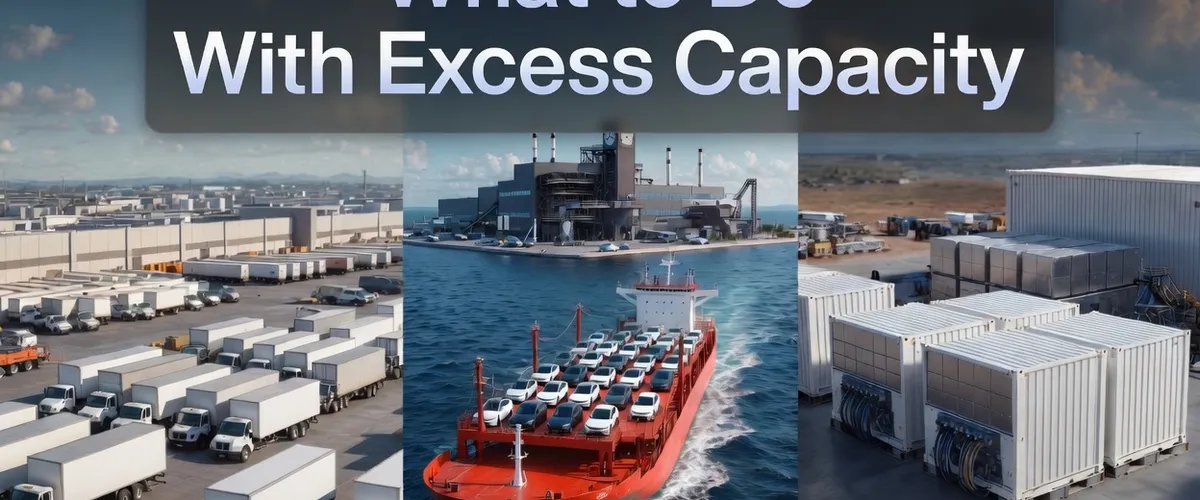
The automotive sector is currently confronting exactly these open capacity opportunities. Stellantis has identified surplus capacity equivalent to four European plants (including Rennes in France, Cassino in Italy, and Madrid) and is in talks with potential partners and buyers, notably China’s Dongfeng Motor, which recently toured several sites. Options include sharing facilities to fill empty lines in exchange for technology or outright sales, an attempt to spread the pain of overcapacity across countries while avoiding politically costly closures. Meanwhile, Ford has fully taken control of its Glendale, Kentucky battery plant (formerly part of the BlueOval SK joint venture with SK On). Rather than let the asset sit idle amid softening EV demand, Ford Energy is repurposing it to produce battery energy storage systems (BESS), targeting at least 20 GWh annually starting in late 2027 for utilities, data centers, and industrial customers. On the logistics side, BYD has turned potential constraints into strategic strength by building its own fleet of eight car carriers. These vessels give the company control over exports, help it dodge tariffs and geopolitical risks (including sailing through the Red Sea and Strait of Hormuz when others divert), and enable nimble responses to weather disruptions, ferrying roughly 300,000 vehicles per year while competitors scramble for third-party shipping.
BYD estimates that its in-house fleet reduces per-vehicle shipping expenses by 30–40% versus third-party chartering, with potential annual savings reaching $1.4 billion at scale. During market tightness, daily charter rates for large car carriers (6,500–9,200 CEU) spiked above $100,000–$150,000, making third-party options far costlier and less reliable. The opportunity cost of fleet ownership includes hefty upfront capital (~$100–130 million per vessel) plus ongoing maintenance, crew, and fuel expenses, but these are more than offset by lower effective costs, dedicated capacity, and operational flexibility in volatile conditions.
Excess capacity is never comfortable, but the companies that treat it as a long-term platform rather than a short-term liability, whether by opening it to partners (who may also be competitors) or repurposing it for adjacent markets, consistently come out ahead. The lesson from Amazon, Stellantis, Ford, and BYD is clear: build at unreasonable scale, optimize relentlessly, and when the surplus appears, find creative ways to monetize or redeploy it before it becomes dead weight.